Austin's Housing Market Is Finding Its Balance. Buyers and Sellers Should Take Notice.
September 2026 Austin Real Estate Market Update | By Matt Prewett, Better Broker, Texas Realty
If you've been following Austin real estate headlines lately, you'd be forgiven for feeling a little confused.
One article says prices are rising. Another says sales are falling. Someone on social media insists the market is crashing, while your neighbor remains convinced their house is worth what it was in the spring of 2022.
So, who's right?
As usual, the answer is a little more nuanced than the headlines suggest.
The September 2026 housing numbers are in, and they paint an interesting picture of a market that's neither booming nor collapsing. Instead, Austin appears to be settling into something we haven't seen consistently in years: a market where buyers have choices, sellers have to compete, and pricing a home correctly actually matters.
Imagine that.
Austin Housing Market: September 2026 by the Numbers
According to the latest report from Unlock MLS, the Austin–Round Rock–San Marcos metropolitan area recorded the following year-over-year change
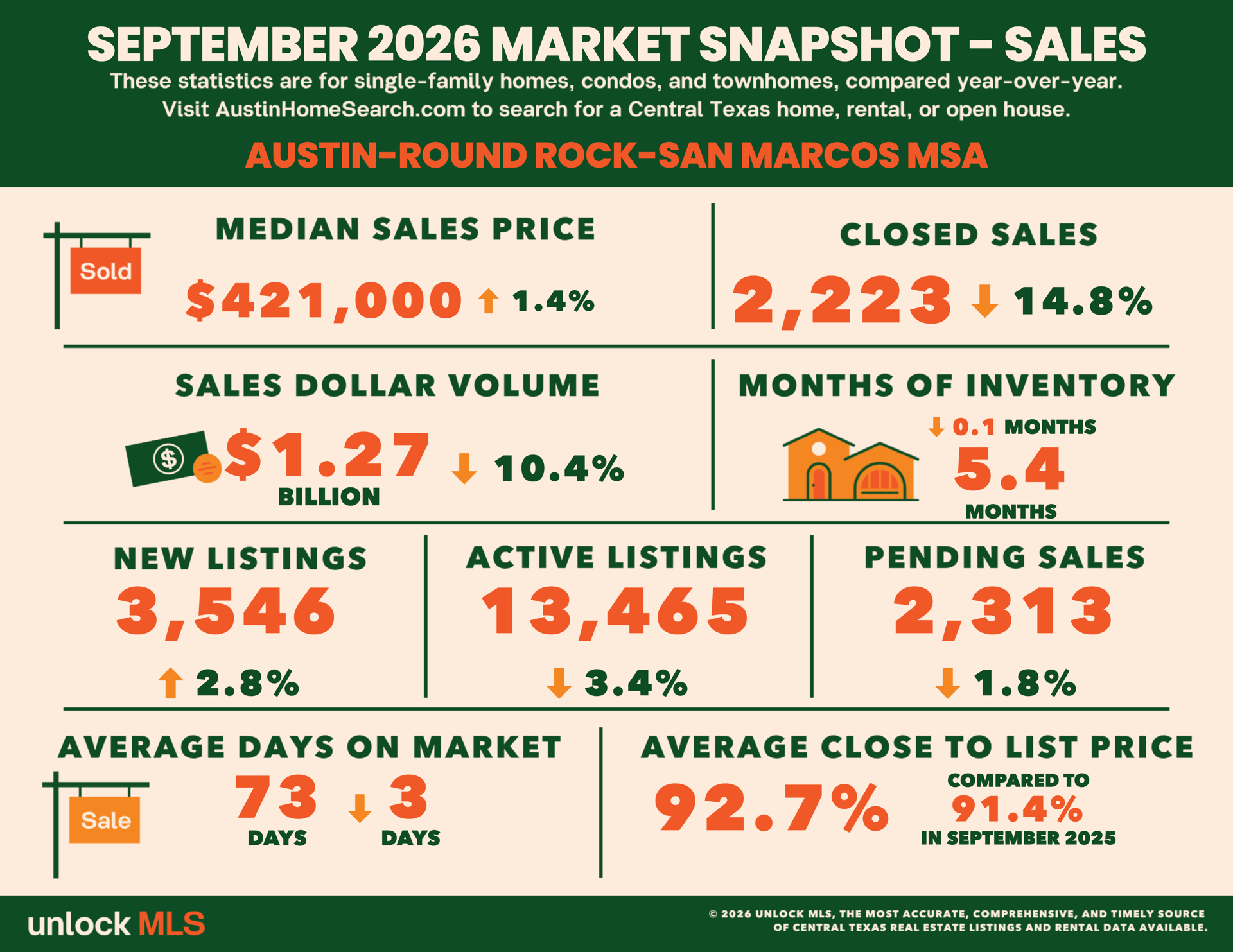
The most interesting takeaway isn't any single number. It's the relationship between them.
Home prices increased slightly, even as closed transactions declined nearly 15%.
That tells us something important: fewer homes are changing hands, but that doesn't necessarily mean sellers are giving their properties away.
Fewer Sales, but Not Necessarily Falling Prices
September's 14.8% decline in closed sales is significant. There's no reason to sugarcoat that.
But the median sales price still climbed 1.4% to $421,000.
How can prices rise when fewer people are buying?
Because sales volume and home values measure two different things.
A decline in transactions can reflect affordability challenges, financing costs, buyer hesitation, or simply fewer agreements being reached. It doesn't automatically mean every home in the market has lost value.
And a rising median doesn't mean every homeowner's property has appreciated, either. The mix of homes sold can influence that figure.
In other words, real estate isn't a stock ticker. Your house doesn't gain or lose value simply because a monthly headline says so.
What matters is what comparable homes in your neighborhood are actually selling for.
The Real Story Is Affordability
Mortgage rates remain one of the biggest obstacles facing today's buyers.
Even relatively small changes in interest rates can make a meaningful difference in monthly payments, particularly when property taxes and insurance are added to the equation.
That's why today's buyers aren't simply asking, "Can I afford this house?"
They're asking, "Does this house make financial sense at this monthly payment?"
And frankly, that's a healthy question.
KXAN's ongoing Austin housing market coverage tracks home prices, inventory, and the pace of sales using information from Unlock MLS and other housing data providers.
That broader perspective matters because affordability isn't determined by purchase price alone. It's the combination of price, financing, taxes, insurance, and the buyer's individual financial circumstances.
For sellers, this means understanding that today's buyers are scrutinizing value more carefully.
For buyers, it means looking beyond the asking price and evaluating the entire financial picture.
Five Months of Inventory: What Does That Actually Mean?
Austin ended September with approximately 5.4 months of housing inventory.
For perspective, a market with roughly four to six months of supply is often considered relatively balanced, although conditions vary substantially by location and price range.
That means buyers generally have more breathing room than they did during the frenzy of 2021 and early 2022.
They can compare properties. Schedule inspections. Consider financing options. And, in many cases, negotiate.
But here's where things get interesting.
Active listings actually declined 3.4% compared with September 2025.
So while sales are slower, inventory isn't endlessly piling up, either.
The market is finding a new equilibrium, even if it hasn't quite decided where that equilibrium belongs.
Sellers: The Market Isn't Punishing You. It's Asking You to Be Realistic.
Here's a statistic worth paying attention to.
In September, homes sold for an average of 92.7% of their original list price, compared with 91.4% one year earlier.
That improvement suggests sellers and buyers may be getting closer to agreeing on what homes are actually worth.
But it also tells us that ambitious asking prices aren't necessarily translating into ambitious closing prices.
And buyers have become remarkably good at recognizing an overpriced listing.
The strategy of listing high just to "see what happens" can become expensive when a property sits on the market, accumulates days, and eventually requires multiple price reductions.
A well-priced, properly presented home can still attract serious interest.
The difference is that sellers now need to earn that interest rather than assume it.
My advice? Price for the market you're in, not the market you remember.
Buyers: Opportunity Doesn't Always Arrive With a Clearance Sign
For prospective buyers, there's plenty to like about the current environment.
More negotiating flexibility, less frantic competition, and additional time to evaluate properties can make for a much more thoughtful purchasing experience.
That doesn't mean every seller is desperate or that every listing is a bargain.
It means opportunities are more likely to come from understanding the individual property.
A home that's been sitting for 90 days may present an entirely different negotiating opportunity than one that's been listed for a week.
A seller who needs to relocate may value certainty and timing as much as price.
And sometimes, negotiating closing costs or a mortgage-rate buydown can be more valuable to a buyer than a modest reduction in the purchase price.
The key is knowing which questions to ask and which opportunities are worth pursuing.
Not All Austin Markets Are Created Equal
One of the biggest mistakes buyers and sellers make is treating the entire Austin metropolitan area as one housing market.
Consider this: while the broader metro reported a median sales price of $421,000 in September, the City of Austin itself recorded a median of $570,958, up 4.2% year over year.
Meanwhile, Williamson County reported a median of $395,000, down 2.5%, and Bastrop County recorded $340,000, down 1.2%.
Same region. Same month. Very different results.
That's why broad market statistics are useful for understanding trends but insufficient for making decisions about an individual property.
A home in Northwest Austin competes with a different set of properties than one in Kyle, Georgetown, or Bastrop.
Real estate has always been local. In a shifting market, that distinction becomes even more important.
What Should We Expect as 2026 Comes to a Close?
Looking at the third quarter as a whole provides some useful perspective.
Across the Austin metro, third-quarter closed sales declined 2.4% year over year, while the median sales price decreased 2.3% to $420,000.
That's a considerably less dramatic picture than September's monthly sales decline alone might suggest.
It also reminds us why one month's statistics shouldn't be mistaken for a long-term trend.
Heading into the final stretch of 2026, affordability, mortgage rates, and local inventory will continue to influence how quickly homes sell and what buyers are willing to pay.
Seasonal slowing may create opportunities for buyers who are financially prepared, while sellers will need to be thoughtful about pricing and presentation.
And anyone promising to predict exactly where mortgage rates or home prices will be six months from now probably deserves a healthy dose of skepticism.
The Bottom Line: A Smarter Market Requires a Smarter Strategy
Austin real estate is no longer operating under the extraordinary conditions we experienced a few years ago.
And that's not necessarily bad news.
Buyers have regained some negotiating power. Sellers are being challenged to price more accurately. And successful transactions increasingly depend on preparation, realistic expectations, and good information.
Personally, I'll take a market driven by sound decisions over one driven by panic and bidding wars any day.
Whether you're buying your first home, selling a property you've owned for years, or simply trying to understand what your home might be worth today, the right strategy starts with understanding your specific market—not just the latest headline.
Real estate doesn't have to be complicated. But it does have to make sense.
And that's exactly what we're here to help with.
Matt Prewett
Better Broker, Texas Realty
512-470-4433
[email protected]
Better information. Better decisions. Better Broker.
Sources & Further Reading
- Unlock MLS — September 2026 Central Texas Housing Report
- KXAN — Austin Housing Market Data & Trends
- KLBJ — Central Texas Home Sales Fall Nearly 15% in September
Market statistics reflect September 2026 residential sales activity reported by Unlock MLS. Days-on-market figures are from a secondary market report. Data is subject to revision. Market-wide averages and medians do not establish the value of any individual property.